STUCK
UNDERGROUND
Mild spoiler warning ahead!
I was walking home one day, when I got a call that the person I loved the most had suddenly passed away. For a while, I retreated from my friends, and completely gave up the very concept of a future. Every day devolved into a routine of waking up, enduring the agonizing weight of the hours, attempting to sleep, and waking up again.
My personal despair was added onto by a paralyzing cynicism. Mark Fisher frequently wrote about reflexive impotence, basically a combo when you’re so aware that things are broken combined with the hopelessness of thinking that nothing can be done. My grief had meshed with this doomerism, creating my own claustrophobic ecosystem. I was entirely convinced that life was a meaningless exercise in enduring pain. It was during the absolute nightmare of a period that I tried working on my backlog, and gave Tengen Toppa Gurren Lagann, a shot.
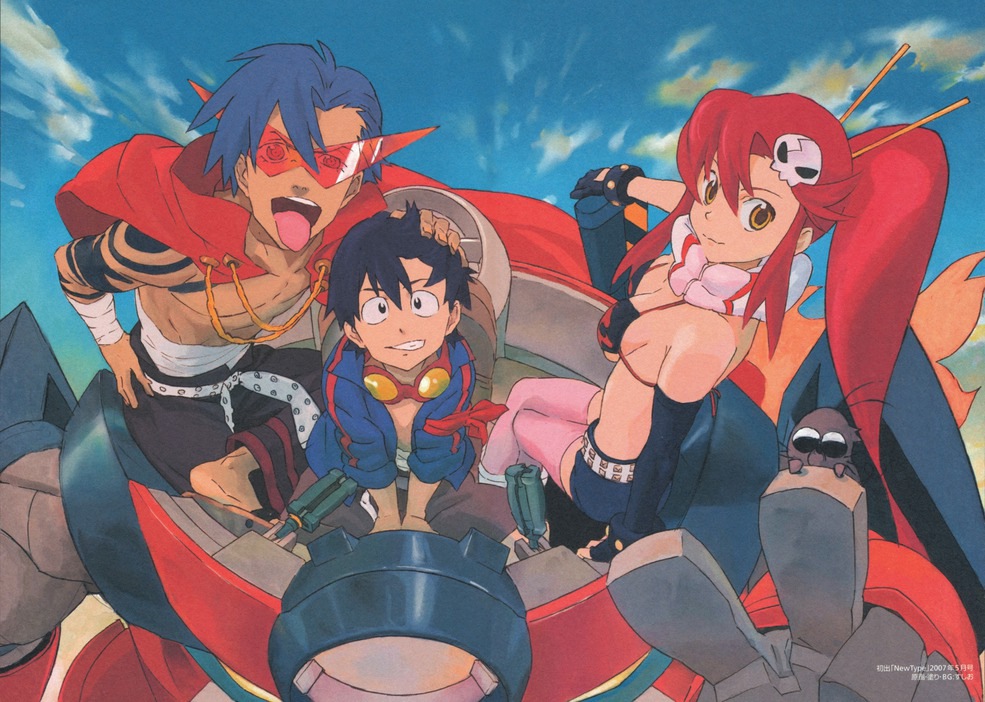
Within the first few episodes, I recognized myself with Simon, the protagonist. He’s introduced as a timid, broken youth living in a village, constantly terrified of the ceiling above him, which could literally cave in and crush him at any moment. He spends his days digging, mindlessly expanding the borders of his dark world for a few scraps of food.
And then, there is Kamina.
At first, Kamina’s loudness and absurd, irrational confidence grated against me. When Simon is paralyzed by fear and self-loathing, Kamina doesn’t offer the empty modern mantra of "just believe in yourself." He intuitively understands that Simon, much like someone in the throes of severe clinical depression, is entirely incapable of generating his own self-worth. Instead, Kamina points to himself and shouts, "Don't believe in yourself. Believe in me! Believe in the Kamina who believes in you!"
Something about the way he said it made me cry in a way I hadn’t in years. When you hate yourself, the demand to love yourself feels like a cruel joke. bell hooks often wrote that we rarely heal in isolation; true healing requires communion and community. Kamina was offering a holding hand for hope. In that moment, I realized that I just couldn’t rely on my own internal strength to stay alive. I had to borrow it. I had to let my loved ones’ belief in my capacity to survive carry me until the day I could finally carry myself.
But Gurren Lagann does not settle for pure, uncomplicated optimism. About a quarter of the way through its run, the narrative pulls the rug out from under the viewer.
Without going into spoilers, what follows is one of my favourite depictions of grief I have ever seen. Contemporary society; and often our own well-meaning peers, expect us to hide our mourning, and quickly return to our roles as productive citizens. But the grief that happens is really ugly and self-destructive.