The world beyond.
Ever since I wrote about it, I’ve been thinking about how much stuff you can find in an old Pokémon town, considering how little of a town is actually there. You can walk through most of them in under 5 minutes, visit most of their buildings, and exhaust a fair amount of its dialogue; yet somehow, I still understand it as a place where people live, with a history and a daily existence that continue beyond the things I’m allowed to do.
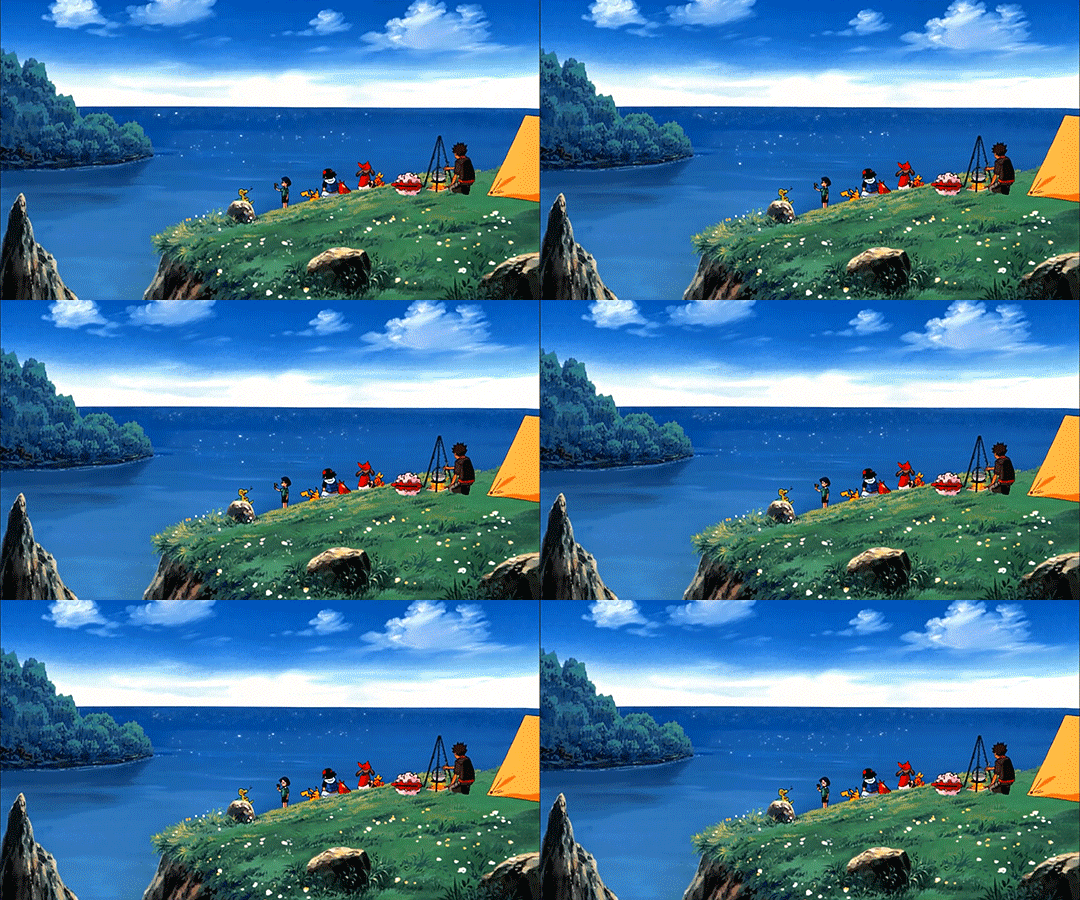
Whenever someone says that an older game's graphics left more to the imagination, the conversation often arrives at nostalgia and stops there. Which is sad, because I feel like there’s so much to talk about!
Take Ecruteak City in Gold and Silver for example, where the towers and their associated stories give the town a proper sense of place. The Burned Tower occupies space within a community that has continued living around it, while the accounts you hear give its history a place in people's conversations. Your visit starts with people who already have concerns of their own, making the town feel older and larger than your route there. The size of it puts ordinary stuff next to evidence of something much older, and the music also helps you time to feel that relationship.
In The Literary Work of Art, Ingarden talks about how a literary work specifies some features of its people and places while leaving others indeterminate. A reader will inherently fill out the lack of info in a piece of work without getting the whole scope of it.
The phrase "filling the gaps" starts to seem a little misleading here, because it can imply that the player makes a more complete image to replace the one on the screen; and I mean, sometimes we do imagine additional detail, especially when we become attached enough. Much of the time, though, the world remains pleasantly unspecified, and I know what it feels like to be there without deciding how everything would appear under closer inspection.
You can imaginatively accept a situation or follow a fictional relationship without visualising it in detail and that matters when talking about games, because everyone expresses their what’s in their head differently, and how much you love a game doesn’t depend on having an unusually vivid visual imagination.
Graphics, like those in pixel art, or early 3D (like the N64 or PS1), can make parts of this process more noticeable, particularly when a face has very few features and the dialogue and posture around it carry more of the available expression. A walk cycle can become distinctive because there is little competing movement; that’s one reason I find the term “bad graphics” not a good description of a visual style that communicates within its limits.
Music does the same thing too! Town themes can make coming back to the Pokemon Center, or church, or whatever safe hub you need, feel restful without you needing to name the feeling. The tune becomes associated with the journeys that brought you back, and its next appearance arrives with some of that accumulated significance. Looking at a still image leaves out the time through which the location became familiar.
The Dreamcast is still my favourite console, which probably makes my affection for this period fairly unsurprising. What interests me about Sonic Adventure's spaces, though, is how happily I can accept their compression. Station Square and the Mystic Ruins connect through a train journey, and that connection helps them belong to the same world even though the way you actually get there is very video gamey. That little journey to the train station gives the transition meaning without requiring the game to model every stretch of land between the two locations.
An older game can offer a manageable place to explore while allowing its implications to remain generous, and the time I spend there gives those implications a personal history. The devs have chosen a form through which I can recognise and care about their world, and I have brought the attention through which that world becomes familiar.
The space we make together.
I love when you start to get that familiarity when you play long enough, it’s kinda like a extension of your senses. A curious corner becomes worth investigating because previous ones have rewarded that attention, or an area feels a bit suspicious because its arrangement resembles somewhere that caught you out earlier. Kinda like how when you start seeing a big empty space in a RPG, you can usually tell there’s some enemy ahead. As your grasp of the game gets better, you develop an understanding of what this particular game considers significant, and you can make guesses about it that would have seemed unreasonable when you first started.
We form expectations, and revise earlier impressions as a game goes on. The relationship between a work and its audience gives the interpretation a character. We understand through an unfolding encounter, with the game guiding us to help us learn.
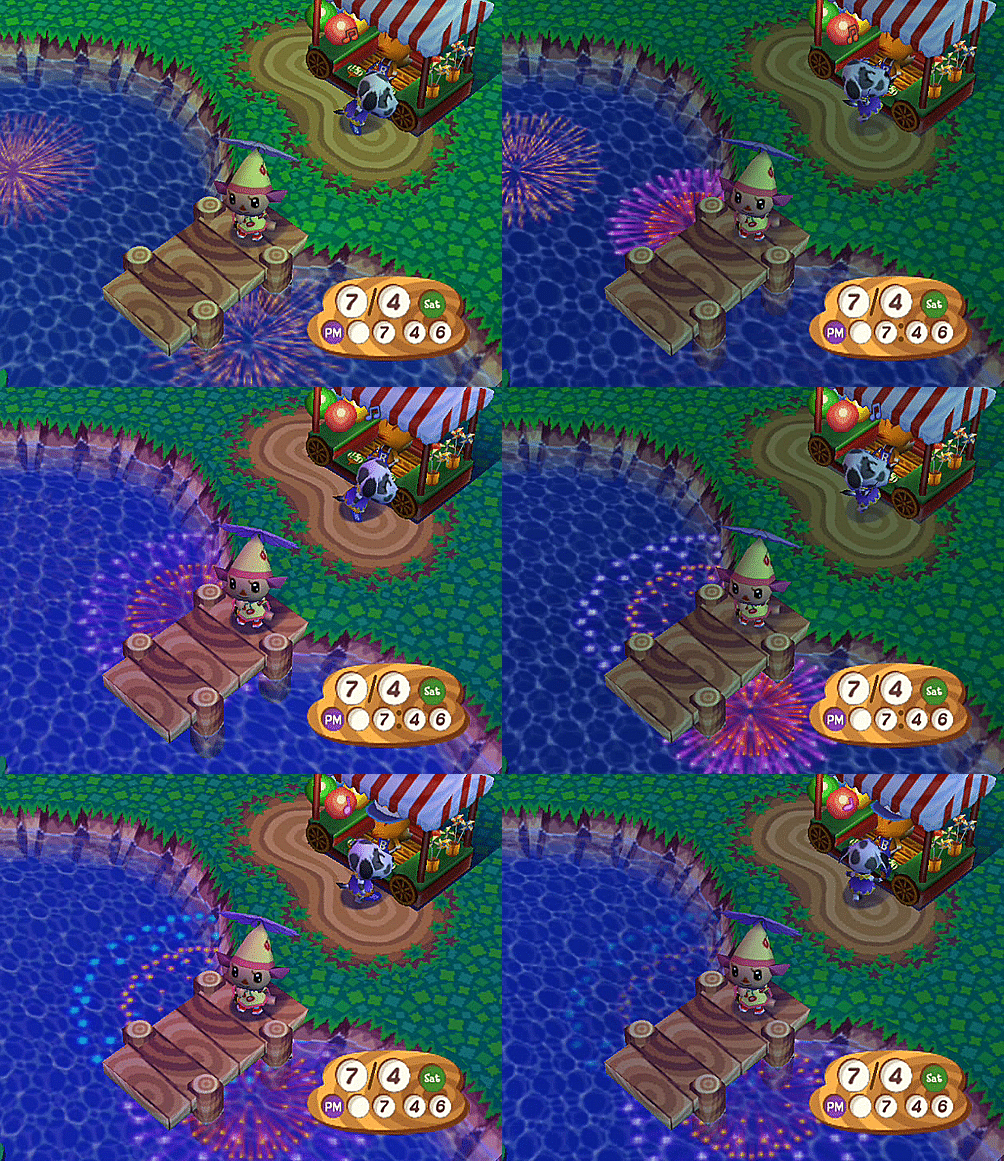
I like thinking of this as a conversation, provided we remember how unevenly its conditions are established. The devs decide which responses the game can produce, and they can’t anticipate every way a player will go about it.
A game's world is communicated partly through what it permits and requires us to do, and a game like Silent Hill makes this relationship particularly easy to examine. Walking through its foggy streets involves decisions about something you can’t look at, and the sound around you can make approaching feel consequential before whatever is there becomes clearer. The distance between noticing a possible threat and identifying it becomes part of the encounter. I can understand that uncertainty intellectually while still feeling the reluctant moving closer, because the game asks me to commit before it supplies complete information.
Toyama talks about how players would connect the game's fragments, and how additional realism could make the remaining conventions of a game stand out. Sato also talks about the expressive possibilities of graphics, and it’s so cool and interesting to me.
Animal Crossing gives us a much different example, and I kinda like having it beside Silent Hill because affectionate familiarity involves plenty of imagination too. Repeated meetings with a villager can give their limited dialogue a personal significance that exceeds itself. Knowing where their house is means that walking past it already brings someone to mind, even when you have no reason to stop. A familiar routine gives a small amount of authored material a continuing place in your day.
Of course, games have always reached people unevenly; a second-hand copy may arrive without its booklet, or a rental may give you only a short time with it. Those kinds of circumstances can create imaginative experiences of their own, but I’m wary of romanticising the disadvantages involved. Having less access can produce ingenuity while also being unfair. The affection someone develops under those conditions deserves respect without turning the conditions themselves into an ideal.
This also places a limit on the idea that audiences finish a work. An imaginative player can make something meaningful out of a frustrating experience, but what they do doesn’t erase the design decisions that caused the frustration. If a game gives poor feedback about an essential action, it is reasonable to criticise that feedback. If its world is thinly characterised, a interpretation should not automatically be credited to the writing. We can appreciate what people bring while remaining specific about what was made. What I mean to say, is proper criticism is good.
Conversely, a player's interpretation doesn’t need to reproduce an author's private intention to become worthwhile. A cutscene might speak to someone's experience of loneliness in a way its creators never discussed, or a small character might become important to somebody whose circumstances made that detail stand out. The artwork still constrains what can plausibly be said about it, but its significance can develop through encounters its makers did not plan.
The World becomes Real
Returning to a familiar scene in a remake can sometimes feel disappointing even when the new performance is thoughtful and is made with care and love. You can appreciate the work while finding that a particular moment no longer leaves you with the same impression. An improvement in one respect can change a quality that mattered in the earlier version, and describing that change deserves more attention than some discourse about which version looks better. (Fuck crowbcat and their dumbass comparison videos btw)
The performance is usually a good place to begin, since a text box gives you words and an order in which to read ‘em, but what hits you emotionally may depend heavily on the context you bring. Once the line is voiced, the actor contributes a particular pace and emphasis. It’s the kinds of decisions that give the person speaking a particular presence that affects how the scene unfolds for you.
That specificity can be wonderful, and I have no interest in treating the work of performers as an unfortunate consequence of better technology. A hesitation can complicate an apparently straightforward statement, while a face can suggest discomfort that the dialogue leaves unacknowledged. Additional information increases the number of plausible interpretations, and detail can give imagination more to work with when the direction allows that to remain.
My concern is with treating the newer version as though it just simply reveals what the old one always meant all along. A new performance necessarily interprets the material, even when everyone involved has studied the original closely. The player may encounter a reading that differs from the one they developed, and you can feel discomfort with that without proving that the actors or artists failed. It’s just that now there’s two artistic encounters to talk about, with different conditions and different possibilities for attachment.
It also helps to distinguish increasing resolution from changing the art itself. Porting a game and just cleaning it up a bit isn’t the same as replacing their proportions, textures, lighting, and animation. Those changes can arrive together in a re-release, which makes it tempting to attribute their combined effect.
Once I started thinking in those terms, the thing where people say “modern graphics killed imagination” became too broad, and isn’t useful anymore. A more cleanly rendered landscape can leave me uncertain about its history, while a deliberately crude game can label everything it expects me to do. The amount I can see and the amount I can know are related in particular situations, but they’re separate design decisions often enough that I want to examine them individually.
Like a completion counter changes the apparent limits of a place without changing its graphics at all. If the game tells me that a room has four secrets and I’ve found three, I understand my remaining uncertainty. I may enjoy completing that task, particularly when I want reassurance that I’ve overlooked something. Without the counter I may not even know, and that’s a question in itself.
The commercial language around games can reinforce that approach when it treats duration and volume as straightforward measures of worth. A large map, or a substantial playtime can be described before someone has spent time with the game itself. The pleasure of developing a personal understanding of a game is harder to demonstrate that way. I personally think it can make qualities seem secondary to quantities that fit better on How Long To Beat.
Money is one of the biggest factors in our decisions as well, and I would feel fucking obnoxious telling someone on a tight budget that they should stop caring how much use they will get from a purchase. Wanting something substantial for your money is understandable, though the concern becomes more difficult when it starts serving as a universal account of artistic value, so a smaller game has to defend its existence in terms that favour a different kind of production. A generous games culture should allow us to discuss affordability without pretending that every good experience can be compared by the hour.
It should also allow us to talk about labour without making exhausted developers responsible for every commercial demand placed on their work. GDC's 2026 State of the Game Industry reporting found that 28 percent of its survey respondents had experienced a layoff within the preceding two years. That’s a finding about the surveyed professionals, rather than a census of the entire industry, but it is substantial evidence of insecurity among the people contributing to it. I’m not going to mince my words when I say that’s fucking insane.
Those figures can’t establish why a particular game has too many markers or an overbearing tutorial. They do make it difficult for me to discuss artistic freedom as though it were simply a matter of individual courage. Experimenting with a different scene, or convincing a team to leave something unresolved all need working conditions that allow judgement to develop. Secure employment and reasonable schedules belong in a conversation about what kinds of games we want people to make.
I am equally wary of assuming that a smaller team or a retro aesthetic guarantees those conditions.
By the time a game reaches us, it might also have accumulated explanations that its developers had little involvement in making. A guide can resolve an obstacle, while a video can reveal a location before we reach it or present a particular reading of an ambiguous scene. Those interventions affect different parts of the encounter, sometimes making it possible to continue and sometimes settling an uncertainty we might have enjoyed exploring ourselves.
I adore the amount of care people put into documenting games, and I have no desire to make curiosity incompatible with asking for help. But what I’d like is more sensitivity to the kind of answer being offered, especially when a small practical hint would be enough and a complete explanation arrives instead.
My own familiarity with games belongs in this too, however inconvenient that is for an argument about graphics.(Have I ever cared though?)
After enough years, I recognise things that once seemed weird to me, and there’s no graphical setting that will restore every part of being inexperienced. The past also has games I’ve forgotten, including the unremarkable ones that would complicate any claim of universal imaginative richness. If I’m going to compare decades of games, I owe the present something fairer than a competition against the handful of old favourites I keep choosing to revisit.
Leaving room for wonder.
Discovering a secret and interpreting an ambiguity also deserve consideration, because they ask different things of our attention. A hidden route can have a definite location and a reproducible method of access, while a character's motive may remain open to several readings even after every relevant scene is available. Adding more hidden content doesn’t just automatically produce the same experience as letting an event be complicated, although a game can definitely make use of both.
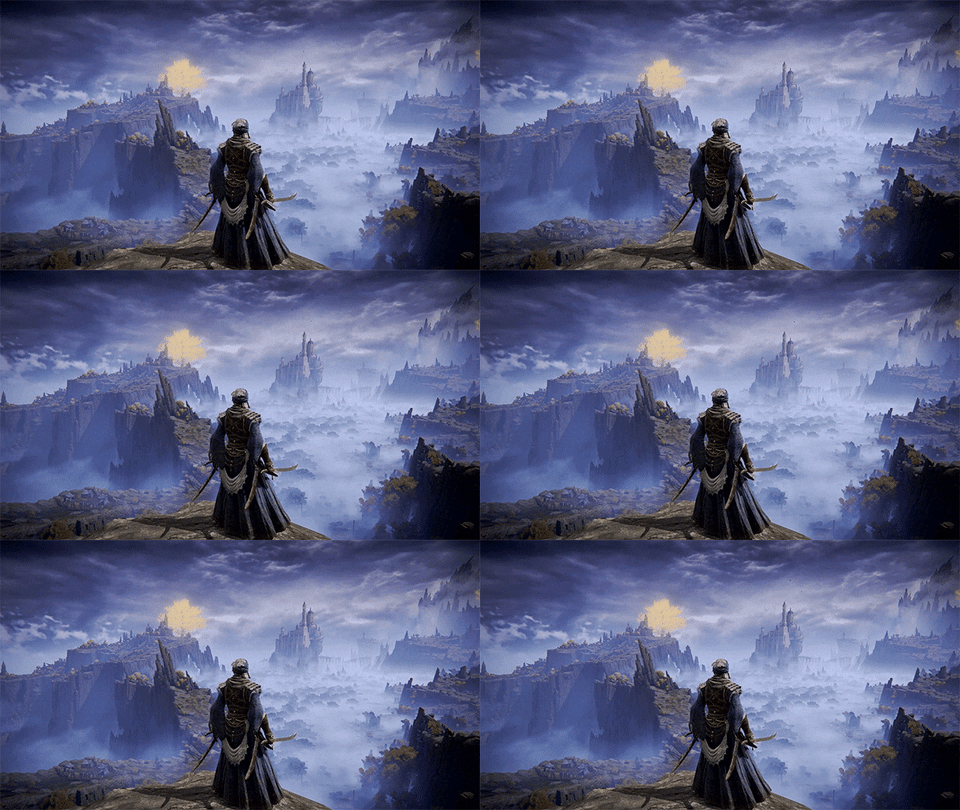
Leaving some details unresolved requires care in how the work establishes those expectations. If a game trains players to treat every conspicuous detail as a puzzle, it’s helped create the expectation that each one can be resolved. Under those conditions, leaving a clue unexplained will probably make someone feel that their attention has been wasted. The little gaps and possibilities of games can be part of its lasting form, some become personal interpretations, and some remain things we are content to wonder about.